You’re running ads. Leads are trickling in. But conversions? Disappointing.
You’ve blamed the agency. You’ve tweaked the creatives. Maybe you’ve even switched platforms. And still – the results just don’t add up.
I’ve had this exact conversation dozens of times. With startup founders in Bengaluru. With manufacturing business owners across Delhi NCR. With D2C brand owners in Mumbai. The frustration sounds the same every time:
“We’re getting traffic but no sales.” “Ad costs keep climbing.” “We’ve changed agencies twice and nothing’s changed.”
Here’s what I’ve noticed in most of these cases. The marketing isn’t the problem. The brand is.
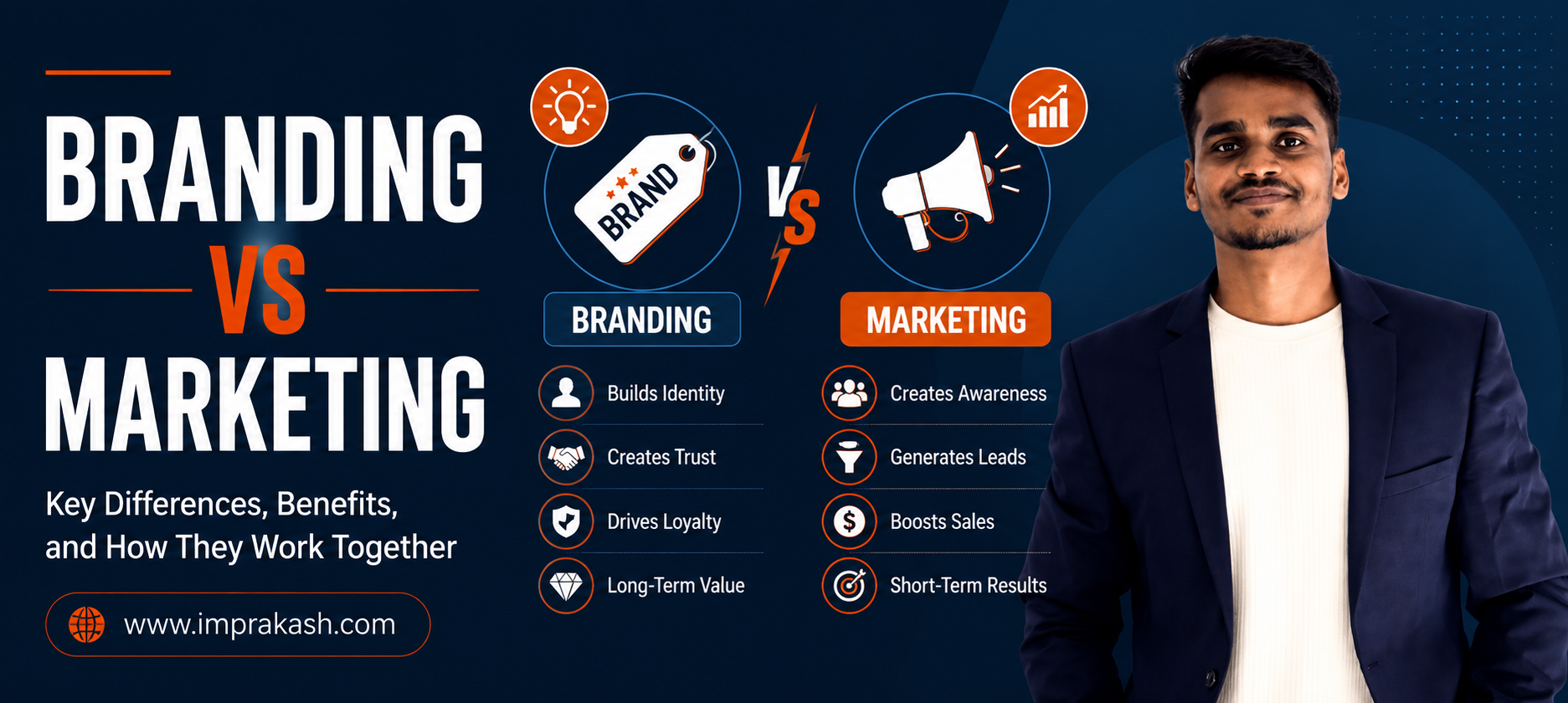
Branding and Marketing Are Not the Same Thing
In most Indian boardrooms, these two words get used interchangeably. That’s a costly mistake.
Branding answers:
- Who are we?
- Who are we for?
- Why should anyone choose us over the competition?
- What do we want to be known for, five years from now?
Marketing answers:
- How do we reach the right people?
- What channels do we use?
- How do we drive demand?
Branding shapes perception. Marketing creates visibility. One without the other is either a beautiful product nobody hears about – or a loud campaign selling something forgettable.
When founders confuse branding with digital marketing, they end up treating ads as a substitute for strategy. Digital marketing is a channel. Brand strategy is the foundation those channels sit on. And no amount of Meta spend can fix a foundation that isn’t there.
So What Comes First : Branding or Marketing?
Every time this comes up in a strategy session, my answer is the same: clarity first, scale later.
You don’t need a 200-slide brand document before you launch your first campaign. But you do need honest answers to a few non-negotiable questions:
- What category are we genuinely competing in?
- What problem do we solve better than anyone else in this space?
- Are we positioning ourselves as premium, value-driven, niche, or mass-market?
- Who are we not for?
Without these answers, your marketing messaging will keep shifting. Every new campaign will feel like starting over.
I worked with a B2B services company in Delhi NCR a couple of years ago. They were running aggressive performance campaigns. Traffic was decent. Conversions were weak. When we dug in, the issue wasn’t the ad targeting or the creatives – it was positioning. They were trying to appeal to everyone, which meant they were resonating with no one. Once we narrowed the focus and rewrote their core messaging, conversion rates improved without any increase in ad spend.
That’s what brand clarity does. It makes every rupee of marketing spend work harder.
Why Your Marketing Isn’t Giving Results
When a founder tells me their marketing isn’t working, I don’t start by auditing the campaigns. I look at differentiation first.
India is one of the most competitive markets in the world. Generic messaging doesn’t just underperform here – it disappears.
If your website copy says something like “high-quality services at affordable prices”– and most SME websites do – you’ve already lost. Customers will compare you on price because you’ve given them nothing else to compare.
Effective brand positioning strategy for the Indian market has to account for things most agencies overlook:
- Regional buying behaviour : what triggers trust in Tier 1 cities is very different from Tier 2 or Tier 3
- Cultural context : language, tone, and values vary significantly across states and sectors
- Price sensitivity : and how to move conversations beyond price
- Competitive landscape : not just who’s spending on ads, but who owns perception in your category
Without that foundation, marketing becomes expensive noise. More spend just amplifies the confusion.
The Branding Mistakes I See Indian SMEs Make Repeatedly
After years of working with businesses across industries, these are the patterns I see most often:
- Treating branding as logo design. A logo is the tip of the iceberg. Brand strategy is everything beneath it.
- Competing purely on price. If price is your only differentiator, you’ll always lose to someone willing to go lower.
- Copying what competitors are doing. Your competitor may be just as confused as you are.
- Changing messaging every quarter. Brand recall takes time. Inconsistency erases it.
- Ignoring internal alignment. If your sales team can’t clearly articulate why a customer should choose you, your brand isn’t working.
When brand strategy is weak, the symptoms show up everywhere – sales teams struggle to close, marketing tests random angles without direction, margins compress, and customers negotiate hard because they don’t perceive any real difference between you and the next option.
These aren’t marketing problems. They’re positioning problems.
The Budget Imbalance That’s Quietly Killing ROI
Here’s something I see constantly with Indian SMEs: their budgets are completely skewed.
A typical allocation looks something like this:
- 85–90% on performance marketing and ads
- Almost nothing on brand strategy
Then there’s frustration when the ROI isn’t sustainable.
Brand strategy isn’t a recurring ad expense. It’s foundational thinking – done once, done well – that makes every subsequent marketing activity more efficient.
When positioning is clear:
- Ad messaging becomes sharper and more relevant
- Landing pages convert better because the value proposition is obvious
- Sales conversations move faster because trust is already partially established
- Customer retention improves because people bought into something they actually believed in
Marketing amplifies clarity. It cannot create it from scratch.
What Does Branding Actually Cost in India?
This is where most conversations stall. Founders either assume branding is unnecessary or assume it’s out of budget. Both assumptions tend to be wrong.
Branding costs in India vary significantly based on scope and depth:
For early-stage startups, a focused branding package typically covers positioning clarity, audience definition, a core messaging framework, and a visual identity system. This is lean, strategic work – not a 60-page brand guidelines document nobody reads.
For established SMEs, branding services often involve deeper work: competitive repositioning, stakeholder alignment, internal messaging frameworks, and sometimes a phased rollout across sales and marketing collateral.
Brand strategy consultant fees in India depend on experience and scope. A full-service branding agency in Delhi NCR or another metro will typically charge more if the engagement includes execution – design, campaigns, and ongoing brand management.
But the more useful question isn’t “what does branding cost?” It’s: how much are you already spending on marketing without a clear brand foundation?
If you’re putting several lakhs a year into ads and still seeing inconsistent returns, strategic brand work isn’t an added cost. It’s a correction to how you’re currently spending.
Branding Consultant vs Branding Agency: Which One Do You Need?
This is a practical question, and the right answer depends on what you actually need.
A branding consultant in India is usually the right choice if you need deep strategic thinking, a collaborative relationship with someone who understands your business context, and a clear positioning framework you can execute on internally or hand off to a team.
A branding agency – especially if they have execution capabilities – makes more sense if you need an integrated team handling strategy, design, and campaign rollout simultaneously, or if you’re managing a large-scale rebrand across multiple touchpoints.
The question to ask either one: Are you defining our strategy, or are you executing someone else’s idea of what we should be?
Execution without strategy creates activity. Strategy creates direction. There’s a big difference between the two, especially when you’re writing the cheque.
What Branding Actually Delivers (And When)
Indian founders are practical people. They want to know the return. That’s fair.
But branding doesn’t produce leads the way a Google Ads campaign does. The returns show up differently:
- Pricing power : the ability to charge more because customers perceive genuine value
- Lower customer friction : prospects already trust you before the first conversation
- Stronger recall ; people remember you when they’re ready to buy
- Better retention : customers who buy into a brand, not just a product, stay longer
- Lower long-term acquisition costs : because word-of-mouth and reputation start doing work for you
When branding is strong, marketing becomes more predictable. You know what you stand for, your message stays consistent, and the right customers find you easier to choose.
When branding is weak, marketing stays reactive. You’re constantly chasing performance, testing new angles, and wondering why the results never quite stick.
Conclusion
Branding v/s Marketing isn’t a theoretical debate for strategy decks. It directly affects your cost per lead, your conversion rates, your margins, and your ability to grow without throwing money at the problem.
If your marketing isn’t converting, the answer probably isn’t more ads.
It might be sharper positioning. A clearer sense of who you are in this market, who you serve, and why that matters.
And sometimes, taking a few weeks to define that clearly, before spending another rupee on campaigns, is the most commercially sensible decision a founder can make.